- Pick what you need and give your kitchen's ZIP code.
- Each service goes to the number of local companies you choose, from one to five. We check licenses where the law requires one and email you their names.
- You talk with them and decide. You hire and pay the company directly.
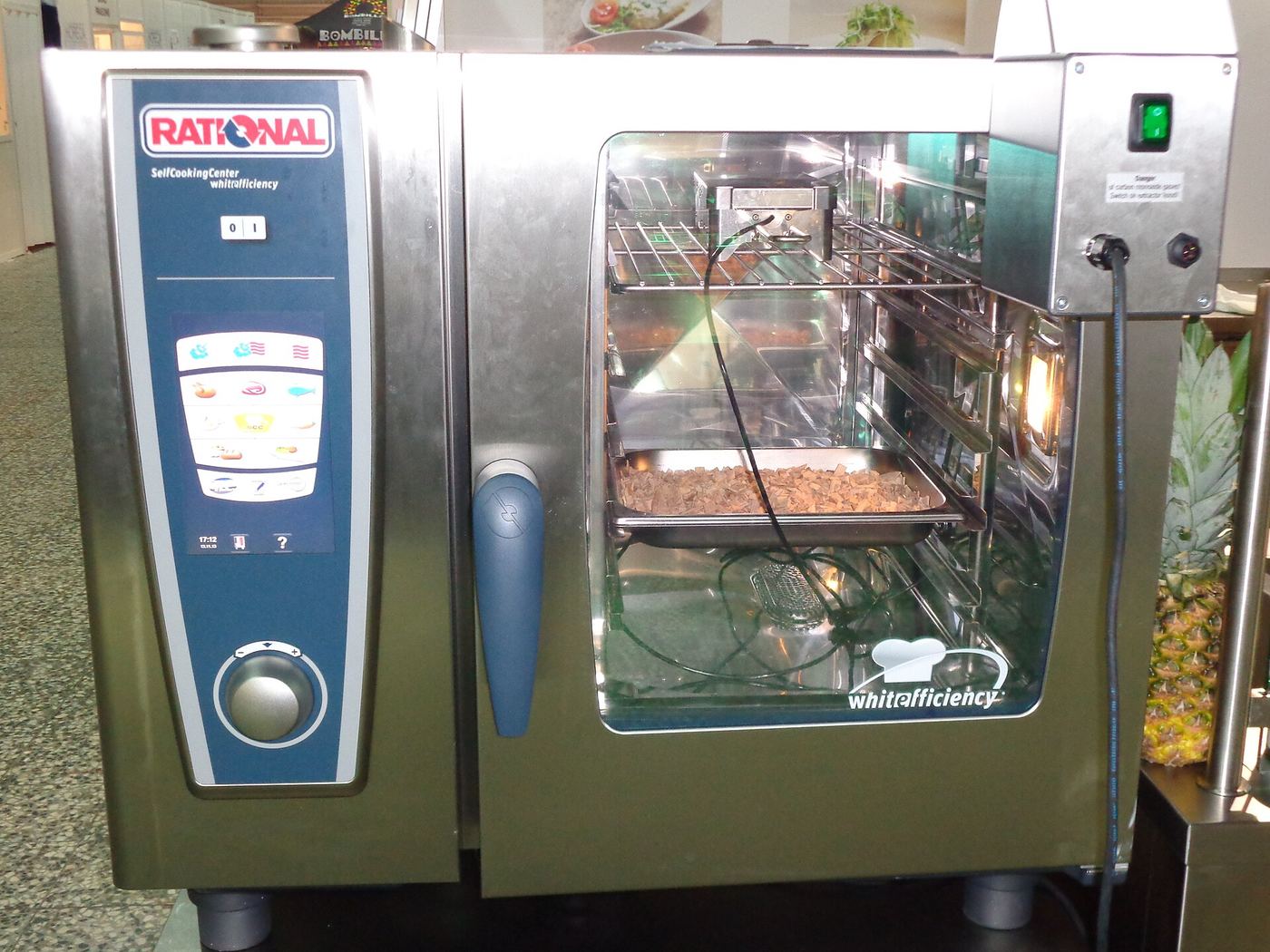
Photo: Travelarz, CC BY-SA 3.0, via source.

Facts checked 2026-11-29.
In New York, a combi oven falls under the 2025 Uniform Code, which has applied to building permit applications since December 31, 2025. Two books in that set decide the hood and its fire protection: the Fire Code and the Mechanical Code. The state health rules in 10 NYCRR Subpart 14-1 decide what the plan reviewer asks to see. Settle the code questions with your local code office before the oven is ordered. The answers change the hood, the gas line and the drain.
1. The state code sections that touch a combi
These are the sections this site's New York guides cite. They come from the 2025 Fire Code of New York State, the 2025 Mechanical Code of New York State and Subpart 14-1.
| Code book | Section | What it means for a combi oven |
|---|---|---|
| Fire Code | 606.2 | A Type I hood over commercial cooking appliances that give off grease vapors, with a short list of exceptions |
| Fire Code | 904.14 | An automatic extinguishing system of a type recognized for cooking equipment and exhaust |
| Mechanical Code | 507.1 | Hoods are Type I or Type II, and one appliance needing Type I makes the whole hood Type I |
| Mechanical Code | 507.2.8 | A Type I hood uses grease filters listed to UL 1046 |
| Mechanical Code | 507.2.11 | A Type I hood carries an approved automatic fire suppression system |
| Mechanical Code | 507.1.7 | A performance test with a capture and containment test, done before final approval |
| 10 NYCRR | 14-1.175 | Hoods keep grease and condensation off walls and ceilings and from dripping on food |
| 10 NYCRR | 14-1.191 | The permit-issuing official may ask for plans showing equipment, plumbing and ventilation |
| 10 NYCRR | 14-1.91 | Equipment materials are nontoxic, durable and nonabsorbent |
The Fire Code's list of referenced standards names NFPA 96 in its 2024 edition and NFPA 17A in its 2021 edition. Local building and code offices review the plans and inspect the work. Buffalo's Department of Permit and Inspection Services is one example.
Section 507.1 catches a lot of combi buyers. A combi often shares a canopy with a fryer or a range. Once any appliance under that canopy needs a Type I hood, the whole canopy is Type I. A combi on a shared line then sits under Type I rules, whatever the oven would need alone.
The county health office adds its own layer. Westchester's plan notice says cooking equipment that makes steam, grease, fumes or heat goes under an exhaust hood. That hood meets NSF Standard 2 and NFPA 96, and the local municipality approves the ventilation. In Suffolk, the plan review guide wants cooking equipment to be commercial grade and NSF approved, or an equivalent. The equipment and food supply guide covers the county plan review side.
2. New York City runs its own rules
Inside the five boroughs, the city's codes apply in place of the state books above. Section 609 of the NYC Fire Code applies to kitchens there. The FDNY restaurant fire safety guide says a cooking exhaust system is filed with the Department of Buildings. A licensed professional files it, and it is installed and approved through that department. Ask the maker whether it holds a city approval for your exact oven.
Get prices for this item. One request, and you pick how many sellers quote it.
Get quotes3. Type I, Type II or ventless
No single source settles which hood a combi needs. The 2021 International Mechanical Code, the model code, lists the combination convection and steam oven as a light-duty appliance. UL's commercial cooking guide files ovens with Type I hood equipment and steamers with Type II. UL also says it does not list Type II hoods.
New York's Fire Code 606.2 gives two ways out of a Type I hood that matter here. One is a recirculating system listed to UL 710B. The other is an electric appliance proven to give off 5 mg/m3 of grease or less under UL 710B. Rational's hood packet reports 1.15 mg/m3 for its electric iCombi 10-full size. The same packet says no fire protection evaluation was done.
| Oven set-up | What the sources say | Ask the code office |
|---|---|---|
| Electric unit with a UL 710B grease report | Fire Code 606.2 lists low-grease electric appliances as an exception | Whether it accepts that report at this address |
| Electric unit with the maker's condensing hood | Unox, Blodgett and Alto-Shaam each sell one; Unox's page makes no UL 710B claim | Whether a Type II hood or none is enough |
| Gas unit | UL's guide limits ductless hoods to electric units; Vulcan puts its flue gas at 480°F | Which hood type goes over the flue |
| Any unit beside a fryer under one canopy | Mechanical Code 507.1 makes the shared hood Type I | Whether the suppression design covers the combi's spot |
Alto-Shaam's own article says each locality sets its hood rules, and most follow the International Mechanical Code. Bring the maker's report to the code office early. The hood and exhaust guide shows what each answer sets in motion.

4. Fire suppression, and why the gas combi stays cold
Section 904.14 of the Fire Code sets the rules for the system over the line. Pre-engineered wet and dry chemical systems are tested to UL 300. Wet chemical systems follow NFPA 17A.
| Fire Code section | The rule | What it means when a combi joins the line |
|---|---|---|
| 904.14.1 | Manual pull near an exit, 10 to 20 feet from the exhaust system and 42 to 48 inches high | The pull stays put, so plan the combi's spot around it |
| 904.14.5.1 | A change of equipment, its position or cooking media brings the system back under 904.14 | Adding or moving a combi under the hood starts a review |
| 904.14.5.2 | Service at least every six months and after any activation | The next service visit checks the new layout |
| 904.14.5.3 | Fusible links replaced every year, frangible bulbs excepted | Links over the combi follow the same yearly change |
The model 2015 International Fire Code adds a detail at 904.12.2. When the system goes off, it shuts off fuel or power to the cooking equipment, and a manual reset brings it back. An NFPA blog post notes these systems are designed around the original equipment. Swapping or moving units without checking the system can leave a fire uncovered. The post is its author's view, not an NFPA position.
Now the part that surprises owners. Many new kitchens get live gas only after the finals have passed. A gas combi can't heat until the maker's start-up is done, and that start-up needs gas. Rational says only a technician it authorizes may run the flue gas check on its gas units. Unox also calls for a flue gas analysis at start-up. So a cold oven at the suppression final is normal and expected.
The inspector still needs to see the shutoff work. Keep the oven's electric supply switched on, so its display or a power light stays lit. When the system trips, the inspector watches that light go out. Tell the suppression company and the inspector about the combi before the test date.
Suffolk County licenses technicians who service or install automatic fire-extinguishing systems, through its Fire Extinguisher Licensing Board. The Suffolk County page has the details. The fire suppression guide covers the rest of the state.
5. Hood distances the makers print
Rational publishes the most spacing figures for its units. The hood should reach 6 to 18 inches past the front, per its spec sheet. Its US install manual gives 6 to 20 inches, with a grease filter in the overhang. At the end of a line, the sheet asks for 6 inches past the side.
| Gap on a Rational unit | Gas unit | Electric unit |
|---|---|---|
| Rear exhaust pipes to grease surfaces | 16 inches | 10 inches |
| Vent pipe up to the hood filters | 16 inches (400 mm) | 10 inches (250 mm), with 450 mm advised with UltraVent |
| Service room on the left side | 20 inches recommended | 20 inches recommended |
| Gap from high-heat units such as fryers | 14 inches, or 2 inches with a heat shield | 14 inches, or 2 inches with a heat shield |
The model 2021 Mechanical Code sets two more points at 507.4.1 and 507.1.1. A canopy hood overhangs the appliance by at least 6 inches on open sides. Its front lip sits no more than 4 feet above the cooking surface. A Type I exhaust fan starts when an appliance turns on, or it is interlocked. With heat or smoke sensors, it starts within 15 minutes. Ask the code office for the matching section in the state book.
Vulcan's Chef'sCombi manual warns that a gas unit's flue stack must not be tightly connected to the hood or duct. A minimum gap to the hood's grease filters must be kept.

6. Size the oven, then size the air
Rational is the only maker read here that prints meals per day. Its packet also gives the exhaust air each size needs standing free. Against a wall on one side, the air drops to 63% of the free-standing figure. Its UltraVent hood cuts it by up to 70%.
| Rational iCombi Pro size | Meals a day | Exhaust air, free-standing |
|---|---|---|
| XS | 20 to 80 | 124 cfm |
| 6-half | 30 to 100 | 234 cfm |
| 10-half | 80 to 150 | 410 cfm |
| 6-full | 60 to 160 | 485 cfm |
| 10-full | 150 to 300 | 810 cfm |
| 20-half | 150 to 300 | 806 cfm |
| 20-full | 300 to 500 | 1,471 cfm |
Rational's brochure works through a restaurant serving 200 meals a day with two 10-half units. Its 10-full carries 66 pounds per level and 198 pounds in all. EPA's WaterSense guide advises against an oven bigger than the menu needs.
7. The gas line and the circuit
Each fuel puts a different load on the building. A gas unit needs a gas line sized for its burner, and an electric one needs a big 3-phase circuit.
| Gas model | Rated input | Gas fitting | Inlet pressure, natural and LP |
|---|---|---|---|
| Rational iCombi Pro 10-full | 152,000 BTU/h natural, 148,500 LP | 1 inch NPT valve (sheet), 3/4 inch NPT (brochure) | 6.5 to 10 and 10 to 15 inches water column |
| Blodgett Invoq Combi 10-2/1 GN | 81,900 BTU/h | 3/4 inch | 7.2 to 10 and 12 to 20.1 inches water column |
| Vulcan ABC7G | 80,000 BTU/h | 3/4 inch NPT | 5 to 10.5 and 11 to 13 inches water column |
| Vulcan Chef'sCombi 10-level full size | 143,310 BTU/h natural | Not on the product page | Not on the product page |
A gas combi still draws power for its controls and fan. Vulcan's 10-level gas unit lists 120 volts at 5.8 amps. Rational's gas 10-full wants a 208 volt single-phase circuit on a 15 amp breaker. An electric 10-full Rational needs 3-phase power and up to a 150 amp breaker at 208 volts. Rational also warns against a receptacle that code requires to have a UL 943 Class A GFCI.
8. Water, drain and backflow
A combi needs a cold water line, a drain and backflow protection. The figures below come from each maker's US sheet or manual.
| Model | Water pressure | Water inlet | Drain |
|---|---|---|---|
| Rational iCombi Pro 10-full | 14.5 to 87 psi | 3/4 inch GHT | 2 inch OD, high-temperature pipe only |
| Unox XAVC-10FS-EPRM | 22 to 87 psi, 29 recommended | 3/4 inch female NPT | 40 mm PVC or similar, on the floor behind |
| Blodgett Invoq Combi 10-2/1 GN | 15 to 87 psi, 1.5 gpm | 3/4 inch GHT | 2 inch |
| Vulcan ABC7G | 30 to 60 psig | 3/4 inch, split into filtered and unfiltered | 1 inch stainless tube to an open drain |
| Electrolux SkyLine Pro 61 | 15 to 87 psi | 3/4 inch | 50 mm |
Rational wants a rear indirect floor drain with an air gap, and its own drain for each unit. A second trap without a vent can make the oven overflow, since it has its own siphon. Its drain water averages 140°F, and the steam generator pumps out short bursts.
New York's health rules sit in Subpart 14-1, not the FDA Food Code. The FDA's model 2022 Food Code still shows what an inspector tends to look for. Section 5-202.13 makes an air gap twice the inlet's diameter and at least 1 inch. Section 5-202.15 asks that water filters can be taken apart for service. Section 5-203.14 protects each point of use from backflow. Suffolk's plan review packet also asks for a sewage disposal questionnaire, so the drain shows up early.
9. Daily care and power cuts
Rational asks for a clean every day, even when the oven only steamed, because grease is a fire risk. The wash cycles run from minutes to hours.
| Maker and system | Shortest program | Longest program |
|---|---|---|
| Rational iCareSystem, 9 programs | Interim clean in 12 minutes | Runs overnight without staff |
| Blodgett CareCycle, 7 cycles | Turbo in 15 minutes, between cooking | Eco+ in 3 hours 39 minutes |
| Electrolux SkyClean, 4 cycles | Short cycle in 33 minutes | Intensive, time not printed |
| Unox Rotor.Klean | Rinse | Long |
Water treatment needs care too. Unox's RO.Care softener is replaced once a year. It goes sooner if 13,000 liters divided by the water's temporary hardness in °dH runs out first. Blodgett changes its HydroShield filter when the screen asks, and within 12 months of install.
A short power cut doesn't always lose the batch. Rational picks up after an outage under 15 minutes. Blodgett restarts after one of up to 30 minutes. A Blodgett cut off mid-clean rinses itself as soon as it is switched back on.
10. ENERGY STAR numbers to compare
ENERGY STAR's Version 3.0 oven rules took effect January 12, 2023. Its food service calculator compares a certified oven with a standard one. The standard figures below are the calculator's baseline, set next to the V3.0 limits. P is the oven's pan count.
| Fuel and mode | Standard combi in the calculator | V3.0 limit for a certified combi |
|---|---|---|
| Electric, convection | 72% efficiency, 1.32 kW idle under 15 pans | At least 78%, idle at most 0.083P + 0.35 kW |
| Electric, steam | 51.8% efficiency, 5.26 kW idle under 15 pans | At least 55%, idle at most 0.133P + 0.64 kW |
| Gas, convection | 48.98% efficiency, 8,747 BTU/h idle | At least 57%, idle at most 140P + 3,800 BTU/h |
| Gas, steam | 36.62% efficiency, 18,656 BTU/h idle | At least 41%, idle at most 200P + 6,511 BTU/h |
The calculator assumes 12 hours a day, 365 days a year and a 12-year life. Its default combi has 10 pans and cooks 200 pounds of food a day. Half goes through convection mode and half through steam, with one 15-minute preheat a day. Dual-fuel combis can't be certified. Search your ZIP code in the ENERGY STAR Rebate Finder before you order.
11. Inspection and yearly service
A combi shows up at more than one inspection. First, the plan reviewer wants its spec sheet, since Suffolk lists equipment spec sheets among its seven plan review items. The code office watches the hood performance test before final approval, and the permit holder supplies the test equipment. The suppression final checks the shutoff, and the fire code official gets a certificate after each six-month service.
After opening, Rational and Unox each call for service at least once a year by an authorized partner. Suffolk County's Fire Extinguisher Licensing Board covers who may service the suppression side there. The opening a restaurant guide puts these approvals in order.
Send one request for a combi oven and it goes to the local sellers you pick, from one to five.
Other kitchen equipment
Questions
Which New York code decides the hood over a combi oven?
Two state books share it. Fire Code 606.2 says when a Type I hood is required, and Mechanical Code 507.1 sets the hood type. New York City uses its own codes.
Can an electric combi skip the hood in New York?
It can where the code office agrees. Fire Code 606.2 lists electric appliances proven at 5 mg/m3 of grease or less under UL 710B among its exceptions.
Why can't a new gas combi heat at the suppression final?
Many new kitchens get live gas only after the finals, and the maker's start-up needs gas. Leave the oven's power on so the inspector sees the shutoff cut it.
How often is the suppression system over a combi serviced?
Fire Code 904.14.5.2 calls for service at least every six months and after any activation. Fusible links are replaced every year under 904.14.5.3.
Does a combi oven need a floor drain?
Yes. Every maker sheet read for this page lists a drain connection. Rational wants an indirect floor drain with an air gap behind the unit, one 2 inch drain per oven.
Sources
- 2025 Fire Code of New York State (DOS PDF), read November 15, 2026
- 2025 Mechanical Code of New York State (DOS PDF), read November 15, 2026
- DOS notice of adoption, 2025 Uniform Code, read November 15, 2026
- 10 NYCRR 14-1.175, ventilation, read November 15, 2026
- 10 NYCRR 14-1.191, plans for food service, read November 15, 2026
- 10 NYCRR 14-1.91, equipment materials, read November 15, 2026
- Westchester County plan notice for food service plans, read November 15, 2026
- Suffolk County plan review guide, read November 15, 2026
- Suffolk County Fire Extinguisher Licensing Board, read November 15, 2026
- Buffalo Permit and Inspection Services, read November 15, 2026
- NYC Fire Code, chapter 6, read November 15, 2026
- FDNY Restaurant Fire Safety Guide, read November 15, 2026
- International Mechanical Code 2021, definitions, read November 28, 2026
- International Mechanical Code 2021, chapter 5, read November 28, 2026
- International Fire Code 2015, chapter 9, read November 28, 2026
- NFPA blog, restaurant fire protection basics, read November 28, 2026
- UL, Commercial Cooking Marking and Application Guide, read November 28, 2026
- FDA Food Code 2022, read November 28, 2026
- Rational iCombi Pro 10-full size spec sheet, read November 28, 2026
- Rational iCombi Pro US brochure, read November 28, 2026
- Rational iCombi Pro installation manual, read November 28, 2026
- Rational iCombi Pro instructions for use, read November 28, 2026
- Rational hood exemption packet, iCombi 6 and 10 full size, read November 28, 2026
- Unox XAVC-10FS-EPRM spec sheet, read November 28, 2026
- Unox Cheftop-X and Bakertop-X user manual, read November 28, 2026
- Unox XAVHC-HC11 condensing hood, read November 28, 2026
- Vulcan ABC7G spec sheet, read November 28, 2026
- Vulcan Chef'sCombi manual, read November 28, 2026
- Vulcan 10-level gas combi oven, read November 15, 2026
- Blodgett Invoq Combi 10-2/1 GN spec sheet, read November 28, 2026
- Blodgett Invoq Combi user manual, read November 28, 2026
- Electrolux SkyLine Pro 61 spec sheet, read November 28, 2026
- Alto-Shaam Prodigi 10-20 Pro, read November 28, 2026
- Alto-Shaam, is my kitchen equipment required to be under a hood, read November 28, 2026
- ENERGY STAR Version 3.0 commercial ovens specification, read November 28, 2026
- ENERGY STAR commercial ovens, key product criteria, read November 28, 2026
- ENERGY STAR commercial food service calculator, read November 28, 2026
- ENERGY STAR Rebate Finder, read November 28, 2026
- EPA WaterSense at Work, combination ovens, read November 28, 2026